Behind the Build · The details behind a Dreamvista home.
Behind the Build · 6 May 2026
Behind the Build: Inside the Walls — AAC and Double-Wall Construction
Walls do more than divide rooms. In a tropical climate they moderate heat, carry services, resist moisture and determine how quiet a house is.
Dreamvista Development
Wall construction rarely appears in a brochure, which is unfortunate, because it affects comfort every day. In a hot, humid climate a wall has several jobs at once: slow the passage of heat, manage moisture, reduce sound, carry concealed services, and provide a stable base for finishes.
What AAC is
Autoclaved aerated concrete (AAC) is a lightweight masonry material made from cement, lime, sand and water with an aerating agent, cured under steam pressure. The result is a block full of fine air pockets — considerably lighter than dense concrete block, and easier to handle, cut and chase.
The air structure is the point. Air is a poor conductor of heat, so AAC has better thermal resistance than dense masonry of the same thickness. It is also non-combustible and dimensionally stable. In Thailand, autoclaved aerated concrete products are covered by standards published by the Thai Industrial Standards Institute (TISI); manufacturers publish technical data for their own products, and those figures are the ones to check rather than general claims.
Thermal behaviour in practice
Two properties matter. Thermal resistance describes how well a wall slows heat flow. Thermal mass describes how much heat a wall absorbs before its temperature changes — heavy walls delay the arrival of outdoor heat indoors.
Lightweight AAC leans towards resistance rather than mass. A denser wall may delay heat longer but transmit more of it; AAC transmits less but stores less. Neither is universally better; what matters is that the wall build-up, orientation and shading are considered together. Shade on a wall changes its performance more than the block specification does.
Two practical notes. First, thickness matters: a thicker wall of the same material performs better. Second, the weakest points in a wall are rarely the blocks — they are windows, junctions and the roof above.
Double-wall construction
A double-wall system uses two leaves of masonry with a cavity between them. The cavity may be left as an air gap or filled with insulation.
The advantages are real: additional thermal resistance, improved sound insulation, and a break that limits the direct transfer of moisture from outside to inside. The costs are equally real: more material, more labour, more wall thickness taken from internal floor area, and more careful detailing at openings, where lintels, cavity closers and damp-proofing must be done properly.
Double-wall construction is therefore a judgement rather than an automatic upgrade. It is most worthwhile on exposed elevations, on west-facing walls, around bedrooms where quiet matters, and between neighbouring properties.
Acoustics
Sound reduction comes from mass, separation and the absence of gaps. Lightweight blocks alone are not exceptional acoustically — they are light, and mass helps. This is where double walls, denser plaster, and careful sealing around sockets, service penetrations and door frames make a noticeable difference.
The common failure is not the wall itself but the openings through it. A single unsealed penetration undermines the performance of an otherwise good wall.
Moisture
AAC is porous. It must be protected from persistent water — by proper rendering and paint systems, by damp-proof courses, by adequate roof overhangs and by waterproofing in wet areas. Correctly installed and finished, it performs well; left exposed to standing water or rising damp, it does not.
Bathrooms, external walls near ground level, and walls behind planters deserve particular attention in the detailing.
Installation is most of the outcome
Material quality is only half the result. The other half is workmanship:
- Thin-bed adhesive mortar applied correctly, with full joints rather than gaps.
- Proper bonding and tying of walls to the structural frame.
- Lintels above openings, correctly sized and bearing properly.
- Movement joints where required, so cracking is controlled rather than random.
- Chases for services cut cleanly, within permitted limits, and made good properly — over-chasing weakens a wall and causes cracking along the line of the conduit.
Concealed services
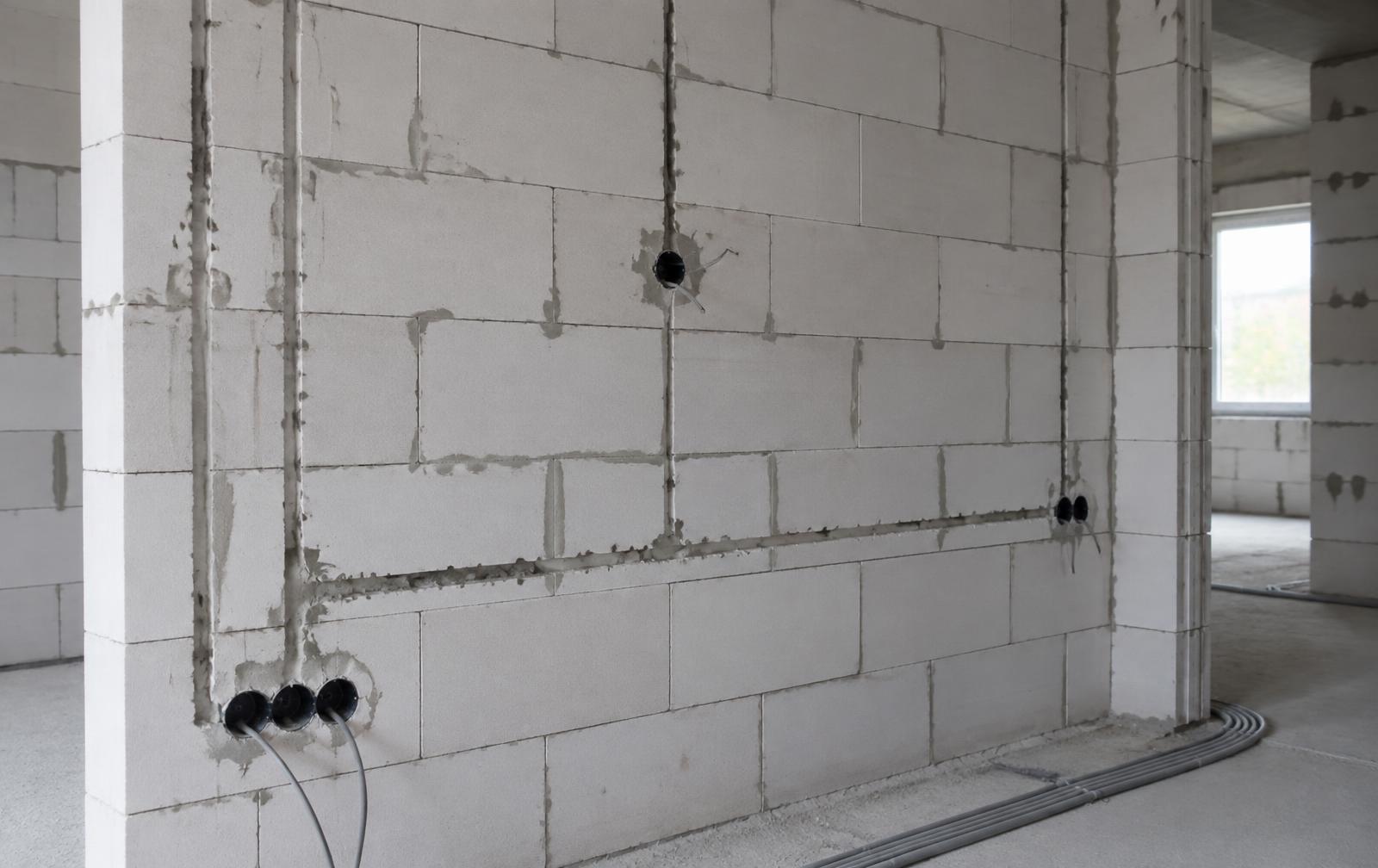
Electrical conduit, water pipes, drainage and air conditioning refrigerant lines all pass through or behind walls. Coordinating these before plastering keeps runs sensible and accessible, and avoids the situation where a wall is chased repeatedly by different trades.
Photographs of walls before they are plastered are genuinely useful documentation. They record exactly where services run — information that becomes valuable the first time something needs to be fixed or altered.
What to ask
Rather than asking which block is best, the more useful questions are: what is the full wall build-up on each elevation, what happens at openings and junctions, how are wet areas protected, and is there a record of services before the walls were closed.
The answers say more about the house than the name of a material.
Common questions
- Is AAC better than dense concrete block?
- It is different rather than universally better. AAC offers higher thermal resistance and lighter weight; dense block offers more mass and sound benefit. The right choice depends on where the wall is and what it needs to do.
- Is a double wall always worth the cost?
- Not everywhere. It gives the most benefit on hot elevations, party walls and rooms where quiet matters, and costs floor area and detailing complexity elsewhere.
- Can AAC be used in bathrooms?
- Yes, with appropriate waterproofing and finishes. Like all porous masonry it must be protected from persistent moisture.
- Why do cracks sometimes appear along service runs?
- Usually because chases were cut too deep or too wide, or were not made good correctly. Careful chasing and proper repair prevent it.
Sources
Dreamvista Development
Wall build-ups, services and detailing are decided before work begins on site.
Explore how Dreamvista approaches development and constructionPrivate Briefings
Private Briefings
Development updates, new projects and selected insights from Dreamvista, sent directly to you.